My English study plan — listening and reading edition
My motivation for studying English has come back after a while.
Looking back at my past English study, one of the biggest reasons I couldn't continue was not knowing what to do next. So this time, I decided to make a study plan first.
Setting a goal
Goal: TOEIC score of 800
One reason I couldn't keep studying in the past was that I had no clear, measurable goal. TOEIC is a very clear number-based goal that is easy to measure, so I set it as my target.
I used to think that a high TOEIC score doesn't mean you can actually speak English, so there was no point in aiming for a high score. But then I realized that's something people who already score high should think about — it's wrong for someone who can't even get a good score to say that. So I changed my thinking.
Choosing what to study
Study targets: Listening and Reading only
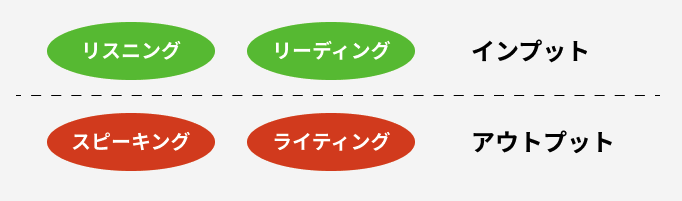
I will focus my study on listening and reading. This is not just because TOEIC tests these skills — English skills can broadly be divided into input and output.
The most important part of communication is listening. If you can't understand what the other person is saying, communication fails. So I decided to focus on input skills: listening and reading.
From experience, if you just want to get your point across, you can manage with middle school-level grammar and vocabulary. The fastest way to improve speaking is to communicate with someone. If you have a certain level of listening ability when you do that, speaking practice will be much more efficient. That's why I'm starting with listening.
Listening study plan
Challenges
- When speaking speed gets even a little fast, I can't catch individual words
- The sounds I imagine and the actual sounds are different
- I don't have enough vocabulary, so words I don't know don't register as words
- Even when I catch words, I can't understand the meaning at natural speaking speed
- If I can't read English sentences quickly, I can't keep up with listening speed
Strengthening pronunciation
Goal: Close the gap between the sounds I think I hear and the actual sounds, so I can understand English words better
I'll try a book recommended in something I was reading, "Eigo Nodo 50 no Method" (50 Methods for English Throat).
Try the book "Eigo Nodo 50 no Method"- It introduces an original method called "throat pronunciation" with its own phonetic symbols. Compared to standard phonetic symbols, the same sound is marked differently, which was confusing.
- Example: map (mˈæp) and man (mˈæn)
- Since looking up a word's phonetic symbol to learn its pronunciation doesn't seem to work with this method, it wasn't a good first book.
- The sense of how to produce sounds was clearer than explanations about mouth and tongue position, so it might be good after getting used to the basics.
- [ ] Work through "Eigo Mimi: Pronunciation Leads to Listening" (改訂3版 英語耳 発音ができるとリスニングができる)
After that, move on to shadowing.
First learn the shadowing method, then find material and do it properly.
- [ ] Work through "Definitive English Shadowing [Super Beginner]"
- [ ] Work through "Definitive English Shadowing [Revised Edition]"
Building vocabulary
Goal: Increase the number of words I know so I can catch more words when listening
Choose one vocabulary book and go through it many times. Try the cycle of studying words at night and checking if I remember them in the morning. A book I read recommended this approach.
The specific book is just one that came up as recommended when I searched — I don't have a strong preference.
- [ ] Go through "TOEIC L & R TEST Deru-tan Tokkyu: Gold Phrases (TOEIC TEST Tokkyu Series)" many times
Strengthening word recognition
Goal: Improve my ability to catch English words when listening
Try 10-second listening as an experiment.
- [ ] Work through "10-Second Listening: A New Method to Dramatically Improve Your Ability to Hear English"
Strengthening reading
Goal: Understand the meaning of English at listening speed
Work on reading study.
Checking listening progress
Goal: Review whether my study methods are effective
Periodically do TOEIC listening practice problems to check if my study is working. If I can't feel any growth, reconsider my study methods.
- Do TOEIC listening practice problems
Reading study plan
Challenges
- When I encounter unknown words, I can't understand the content
- Simply don't know the words
- My reading speed is slow
- I often lose track of modifier relationships and go back, which takes time
- Sometimes I lose track of sentence structure and lose the subject and verb
Building vocabulary
Goal: Reduce unknown words to understand text
When I feel like I can't understand a text, it's usually because it has many words I don't know. So if I just learn the words, my reading ability should improve a lot.
The approach is the same as "Building Vocabulary" in the listening section.
Reviewing English grammar
Goal: Understand English sentence structure and quickly identify modifier relationships
I realized I've forgotten more middle and high school grammar than I thought, so I'll relearn from scratch.
I'll try "Reading Textbook" after finishing "Basic Textbook" and add it as a second book if it seems good.
- [ ] Work through "English Basic Textbook — Understand from Zero"
- [ ] Work through "English Reading Textbook — Understand from the Basics"
Improving reading speed
Goal: Read English faster so I can keep up with listening
Looking back at when I struggle, I sometimes read English right-to-left after reading the whole thing. I want to be able to read English left-to-right directly.
I'll read overseas tech blog articles continuously using this method.
When I encounter a sentence I can't parse, I'll use slash reading to understand the structure.
- Read through the whole article
- Look up the meaning of every unknown word
- Read the whole article again
- Repeat step 3 until I can finish within a set time
- [x] Work through "Amazing English Reading Technique: Read English Sentences Smoothly While Keeping Your Japanese Brain"